
Why UK Students are Rethinking the Traditional Essay Workflow

The undergraduate journey across UK universities has hit a massive turning point. For generations, the standard method for handling university assignments was simple, if exhausting: sit in a campus library, gather a stack of heavy textbooks, write a solitary rough draft, and spend long nights manually fixing formatting and commas before submission. It was a slow, linear process that assumed every student had endless hours to dedicate exclusively to campus life.
However, higher education has shifted radically. Today’s undergraduate students face an entirely different landscape marked by shifting grading rubrics, rigid academic integrity checks, and a severe cost-of-living crisis that forces many to balance full-time modules with part-time jobs. Because of these intense pressures, the old ways of studying are breaking down. Undergraduates are completely reconstructing how they research, outline, and polish their long-form academic papers.
When balancing a part-time job alongside a rigorous academic schedule, the immediate instinct for many undergraduates under a tight deadline is to seek professional support or search for services that can effectively write my paper for me cheap and reliably. This widespread reality highlights a larger trend: students are moving away from traditional, isolated writing and embracing an ecosystem of collaborative tools and support networks. The modern essay workflow has transformed from a stressful solo marathon into a strategic, multi-stage digital pipeline.
The Pressure Cooker: Why the Old Methods Are Failing
The traditional way of writing an essay fails because it does not fit the lifestyle of a modern undergraduate. In the past, writing a major paper was viewed as an exercise in sheer endurance. You were expected to experience writer’s block, spend days lost in confusing journal databases, and manually organize complex citation styles like Harvard or MHRA.
[Traditional System] ──► Isolated, Slow, Hard Copies, Heavy Textbooks
VS.
[Modern Workflow] ──► Connected, Fragmented Time, Digital Frameworks, Targeted Support
Several critical factors are driving this shift away from the old university habits:
- Severe Time Constraints: A large percentage of UK undergraduates work part-time to pay for rising rent and living costs, leaving fewer continuous blocks of open time for library research.
- Elevated Grading Requirements: Professors now look far beyond basic memorization. They want to see deep critical analysis, interdisciplinary reasoning, and authentic arguments that stand out from automated text.
- Mental Fatigue and Procrastination: Staring at a completely blank screen causes massive psychological friction, leading to severe anxiety and missed deadlines.
Deconstructing the Shift in Student Habits
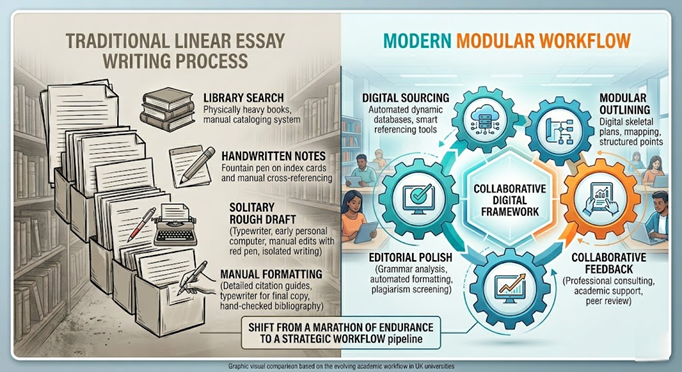
To adapt, successful undergraduates are breaking their writing down into highly specialized, manageable components. Rather than trying to research and write an entire piece in one giant, overwhelming session, they treat the essay like a building project that requires different tools for different phases.
| Essay Phase | Old Linear Workflow | Modern Modular Workflow |
| Discovery | Reading entire physical books and highlighting pages manually. | Using dynamic reference systems to extract key paragraphs instantly. |
| Drafting | Typing from scratch on a blank screen while worrying about grammar. | Building structural outlines and using prompt systems to map out core arguments. |
| Refinement | Self-editing and relying on basic spellcheckers before submission. | Integrating professional proofreading and targeted academic consulting. |
This structural table shows that the real change lies in the drafting phase. Overcoming the initial friction of starting an essay is often the hardest hurdle for any student. Utilizing an automated paper typer or a digital prompt generator can help students break through writer’s block by instantly mapping out a rough skeletal outline, which can then be rigorously researched, fact-checked, and expanded manually.
By utilizing structured resources by MyAssignmentHelp, students are able to study custom-tailored essay structures that demonstrate exactly how a top-tier argument should flow. This approach helps students see the big picture of their topic before they get bogged down in technical vocabulary, transforming drafting from a guessing game into a clear, manageable process.
Rebuilding the Structural Blueprint
With the old habits fading, what does a reliable, modern undergraduate essay routine actually look like? It generally builds upon a clean, three-tiered framework designed to protect your time and maintain high quality.
┌─────────────────────────────────────────────────────────┐
│ 1. THE INFORMATION MATRIX │
│ Digital tag folders, organized source quotes, metrics │
└────────────────────────────┬────────────────────────────┘
▼
┌─────────────────────────────────────────────────────────┐
│ 2. THE CORE ARCHITECTURE │
│ Skeletal outline, logical paragraph transitions │
└────────────────────────────┬────────────────────────────┘
▼
┌─────────────────────────────────────────────────────────┐
│ 3. THE EDITORIAL POLISH │
│ Fact-checking, proofreading, structural evaluation │
└─────────────────────────────────────────────────────────┘
Phase 1: The Information Matrix
Modern research is all about filtering out the noise. Instead of printing dozens of PDF files, students use digital library folders and citation tags to categorize evidence by theme. By organizing your evidence before you write a single sentence, you ensure your paper maintains a strong, evidence-backed foundation.
Phase 2: The Core Architecture
A great essay lives or dies by its logical flow. Undergraduates are moving away from rambling introductions and are instead using clear structural patterns. Each paragraph must serve as a stepping stone that guides the reader naturally to the next point without confusing jumps in logic.
Phase 3: The Editorial Polish
The final phase requires shifting your focus from the ideas themselves to how those ideas are delivered. This means evaluating the balance of your arguments, tracking your word count metrics, and verifying that every single claim connects back to your main thesis statement.
Navigating Academic Integrity in a Digital World
As the writing process becomes more reliant on digital tools, maintaining true academic integrity has become a major talking point across UK universities. Professors are heavily trained to spot generic, uninspired essays. This means the human element of your writing—your personal voice, your unique interpretations, and your critical thinking—is more valuable than ever before.
Crucial Academic Rule: Digital tools and consulting resources are excellent for brainstorming, learning structural frameworks, and defeating writer’s block. However, the final draft must always reflect your own critical thinking, rigorous human fact-checking, and authentic analytical voice.
Smart students use external support to understand complex topics and learn how to write better, rather than using it as a shortcut. Seeing a perfectly formatted reference list or a well-structured argument gives you an excellent template to follow, helping you develop the independent writing skills that university examiners reward.
FAQs: Mastering the Modern Essay Workflow
Q.1 How can I write essays faster without lowering my final marks?
Ans: The best way to save time is by splitting your research phase completely apart from your writing phase. Create a highly detailed outline containing all your source arguments before you start typing sentences. This keeps you focused on your vocabulary and logical flow, rather than forcing you to pause and search for missing evidence every few minutes.
Q.2 What is the most reliable way to avoid writer’s block?
Ans: Writer’s block happens when you try to generate ideas and edit your grammar at the exact same time. Separate these tasks. Focus on getting a rough, imperfect structural draft down on paper first, and save the fine-tuning, spellchecking, and polishing for a completely separate editing session later on.
Q.3 Why do UK professors place so much value on paragraph transitions?
Ans: In UK higher education, an essay is viewed as a single, continuous line of reasoning. If a paragraph feels completely disconnected from the one before it, the reader loses track of your main point. Using strong transition words and clear concluding sentences helps prove that your research is unified and well-planned.
About The Author
My name is Ruby Walker, and I am a senior academic consultant and digital content strategist at MyAssignmentHelp. With over seven years of experience in the higher education sector, I specialize in helping undergraduate and postgraduate students optimize their research frameworks, overcome structural writing bottlenecks, and adapt to modern digital learning workflows.